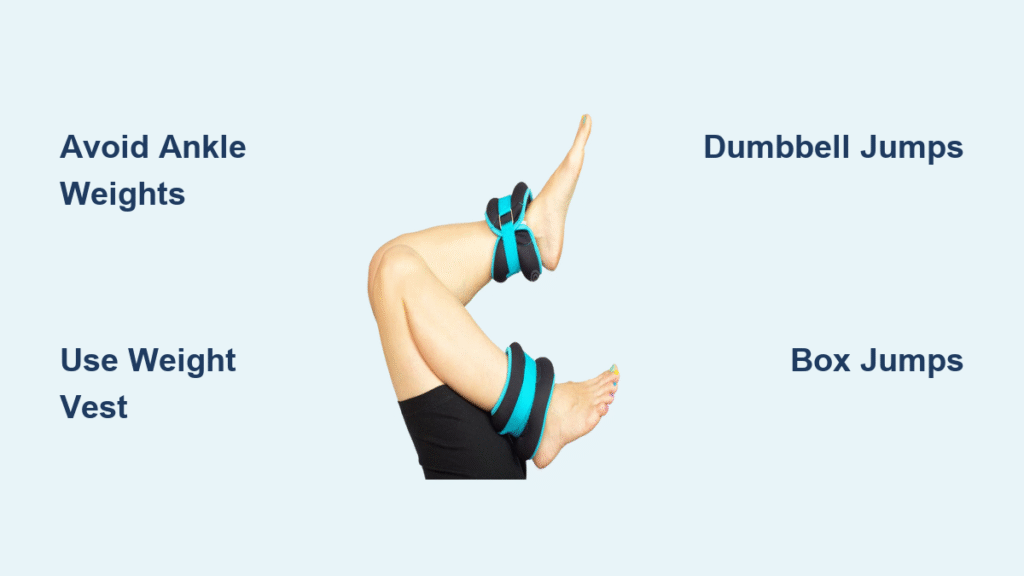
You’ve been promised that strapping on ankle weights will send you soaring toward the basketball rim, but after weeks of weighted jumps, you’re still grounded. That frustrating plateau isn’t your fault—it’s the ankle weights sabotaging your vertical jump progress from day one. While fitness influencers and outdated training programs continue pushing this method, biomechanics research and professional athletic trainers agree: ankle weights deliver zero vertical jump benefits while dramatically increasing your injury risk.
The vertical jump requires explosive power generated through proper triple extension of your ankles, knees, and hips. Ankle weights disrupt this fundamental movement pattern by placing resistance below your primary power generators, essentially training your body to jump poorly. Instead of building explosive power, you’re conditioning yourself to move with compromised mechanics that limit your true jumping potential.
Why Ankle Weights Fail Vertical Jump Training
Load Placement Destroys Effectiveness
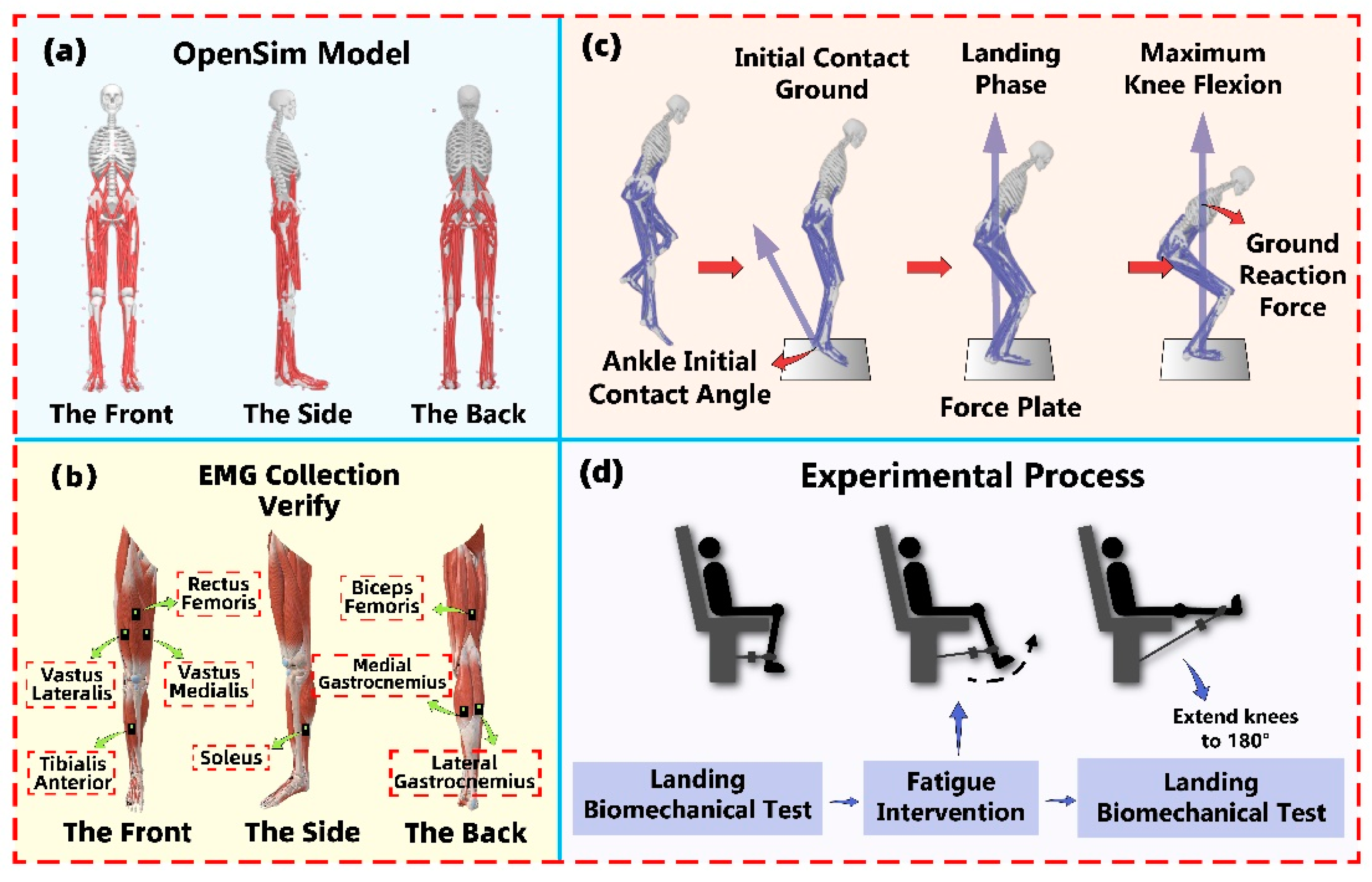
Ankle weights position resistance below your knee and hip joints—the exact opposite of where vertical power originates. This fundamental flaw means your quadriceps receive zero additional loading during both the loading and jumping phases, while your glutes experience minimal resistance despite generating 70% of your jumping power. The visual is simple: imagine trying to bench press with weights strapped to your elbows instead of held in your hands. The load placement makes the exercise useless for chest development.
Your calves get slight overload, but not enough for meaningful strength gains that translate to higher jumps. Research shows that effective jump training requires resistance placed where it directly challenges the primary movers—your hips and knees. Ankle weights simply can’t deliver this critical stimulus where it matters most for vertical leap development.
Triple Extension Breakdown
Vertical jumps require simultaneous extension of your ankle, knee, and hip—the “triple extension” that propels you upward. Ankle weights disrupt this crucial movement pattern by preventing adequate knee and hip extensor loading while creating forward weight shift that alters natural jumping mechanics. Your body compensates for the unnatural weight distribution, reducing ground contact efficiency during the stretch-shortening cycle.
Your body adapts to the specific demands placed upon it. Ankle weights demand poor mechanics, so you get better at jumping poorly. Elite jumpers like Kadour Ziani, who maintained elite jumping ability into his late 40s, never relied on ankle weights because they undermine the very mechanics that create explosive power.
Hidden Injury Risks of Weighted Jumps
Joint Stress Multiplication
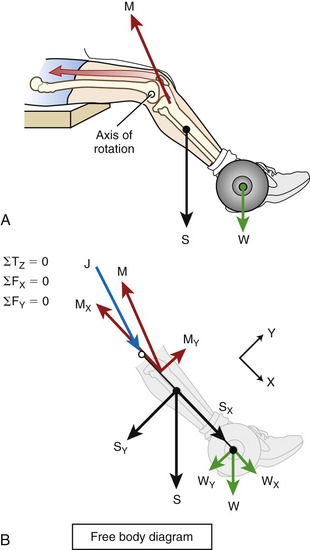
Every landing with ankle weights creates destructive forces on your joints. Knee shear forces increase 3-4x during landing phases as your body struggles to stabilize the unnatural weight distribution. Coordination patterns become corrupted as your muscles compensate for the misplaced resistance, while extended ground contact time prevents explosive power development.
The injury pattern is predictable: athletes develop jumper’s knee, shin splints, or ankle instability within weeks of weighted jump training. Your landing mechanics deteriorate with each repetition, creating a dangerous cycle where poor form leads to more injuries, which further compromises your jumping ability.
Risk vs. Reward Reality
Ankle weight training presents extremely high injury probability with essentially zero performance benefit and poor long-term athletic development. Compare this disastrous ratio to proven methods like weight vest training or plyometric progressions, which offer superior results with minimal injury risk.
Consider this reality check: professional basketball, volleyball, and track programs have abandoned ankle weights for vertical jump training because the risk simply doesn’t justify the nonexistent rewards. Your training time is valuable—why waste it on methods that actively harm your progress?
Proven Alternatives That Actually Work
Weight Vest Training Protocol
Positioning load above your hips transforms external resistance into vertical jump gains. This approach ensures your hip extensors receive full loading throughout complete range of motion, while your knee extensors activate properly during both eccentric and concentric phases. Most importantly, natural movement patterns remain intact while adding progressive overload.
Start with 5-10% bodyweight vest during box jumps and depth jumps, progressing 2-3% weekly as technique remains solid. This method provides the resistance where it matters most—directly challenging the muscles responsible for vertical power without compromising your movement quality.
Dumbbell Jump Progressions
Light dumbbells held at your sides provide superior loading mechanics for jump training. The load positioned closer to your center of mass preserves natural jumping mechanics while offering adjustable resistance from 5-25 pounds per hand. This versatility works across multiple plyometric variations without the joint stress of ankle weights.
Begin with 5-pound dumbbells for 3 sets of 5 jumps, adding weight only when landing mechanics stay perfect. Unlike ankle weights, dumbbells enhance rather than disrupt your triple extension, making them ideal for developing real vertical jump power safely.
Gravity-Based Loading Systems
Box jumps create natural eccentric loading without external weights. Stepping off 12-24 inch boxes increases eccentric demand while replicating true jumping mechanics through full movement patterns. Progressive overload is achieved through box height increases rather than dangerous external weights, significantly reducing joint stress.
For advanced development, combine box jumps with depth jumps to enhance your stretch-shortening cycle—the key to explosive power. This gravity-based approach delivers superior results without the injury risks associated with ankle weights.
When Ankle Weights Might Help (And When They Won’t)
Limited Conditioning Applications
Ankle weights serve only narrow purposes in jump training contexts. During jump rope conditioning, small range of motion reduces joint stress while building calf endurance. They also work for core strengthening through hanging leg raises and for controlled hip flexor raises that improve sprint mechanics.
Critical understanding: these applications build general conditioning, not vertical jump power. Unweighted double-unders provide superior vertical jump training stimulus compared to weighted jump rope sessions. Reserve ankle weights for 10-15 minutes of post-training accessory work, never as your primary jump training method.
12-Week Jump Training Blueprint
Phase 1: Foundation (Weeks 1-4)
Focus on perfecting movement patterns without external load through box jumps (3×5 at comfortable height), depth jumps (3×3 from 12-inch box), and single-leg bounds (2×8 each leg). Allow 48-72 hours between sessions for proper recovery.
Progress to Phase 2 only when you land softly and quietly on every repetition—this indicates proper mechanics and neuromuscular control. Rushing this phase with premature loading guarantees poor results and potential injury.
Phase 2: Progressive Loading (Weeks 5-8)
Introduce external resistance strategically with weight vest box jumps (3×3 with 5-10% bodyweight) and dumbbell squat jumps (3×5 with light dumbbells). Follow a strict loading protocol: add 2-3% vest weight or 2.5-pound dumbbells weekly only if mechanics stay perfect.
Quality trumps quantity—stop a set when your jump height drops 10% from your best rep. This prevents reinforcing poor mechanics through fatigue, which is far more valuable than completing arbitrary rep counts.
Phase 3: Advanced Power Development (Weeks 9-12)
Combine multiple loading methods for elite gains through complex training (weight vest jumps followed by unweighted max effort) and contrast loading (heavy vest contrasted with light vest). Incorporate sport-specific patterns like approach jumps while emphasizing recovery.
Test your vertical jump height every 2 weeks under identical conditions. Realistic progress expectations: beginner athletes gain 2-4 inches, intermediate athletes 1-3 inches, and advanced athletes 0.5-2 inches in 12 weeks.
Ankle weights for vertical jump training represent outdated methodology that fails basic biomechanical analysis. Replace them with weight vests, dumbbells, and gravity-based loading systems that provide real results without destroying your joints. Your future self—with higher jumps and healthy knees—will thank you for making the switch today. Remember the sustainable training philosophy of elite jumpers: technique perfection always comes before added resistance, progressive patience yields consistent gains, and injury prevention ensures you’ll keep jumping higher for years to come.