You clip on lightweight ankle weights during your morning walk, expecting subtle leg sculpting—only to develop nagging knee pain by week three. This common scenario reveals why most ankle weight training fails: users treat these compact tools like magic toners rather than precision instruments. Recent studies confirm that improper use (like overloading or high-impact activities) increases injury risk by 47%, while scientifically guided protocols deliver measurable glute activation and gait improvements. Whether you’re rehabbing a minor injury or optimizing home workouts, this guide reveals exactly how to harness ankle weight training for real results without joint strain.
Forget generic “toning” promises. Ankle weight training works through biomechanical leverage—placing even 1–3 pounds at your ankle creates 10–15 pounds of resistance near your hip due to the extended lever arm. This transforms simple movements into targeted strength sessions, as proven in 2016 Malaysian trials where participants using 0.5kg weights three times weekly achieved reduced waist circumference and increased muscle mass. You’ll discover clinically tested protocols for muscle activation, walking progression, and injury prevention—all backed by physical therapy research.
Select Your Ankle Weights Like a Pro
Never Guess Your Weight Load
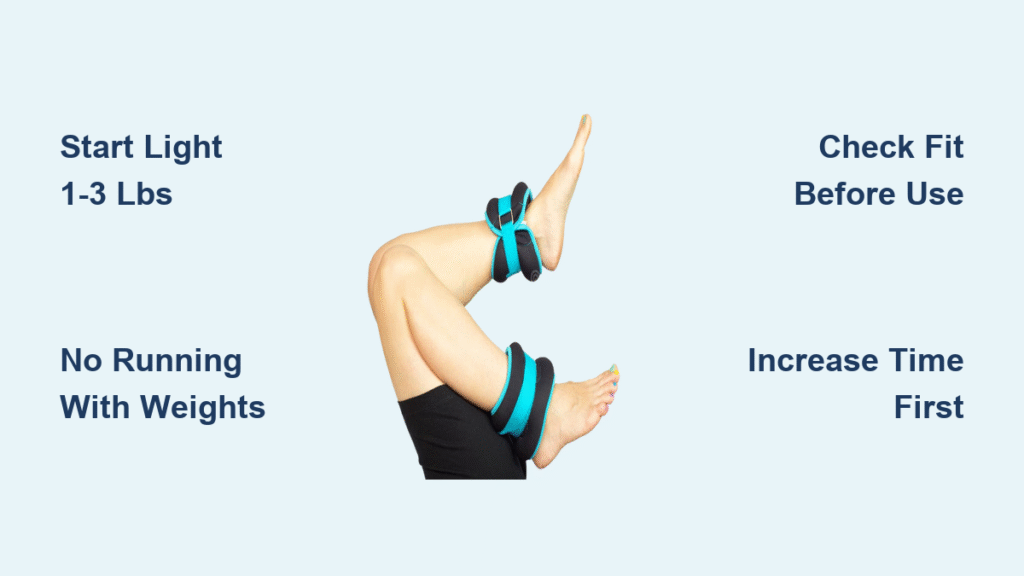
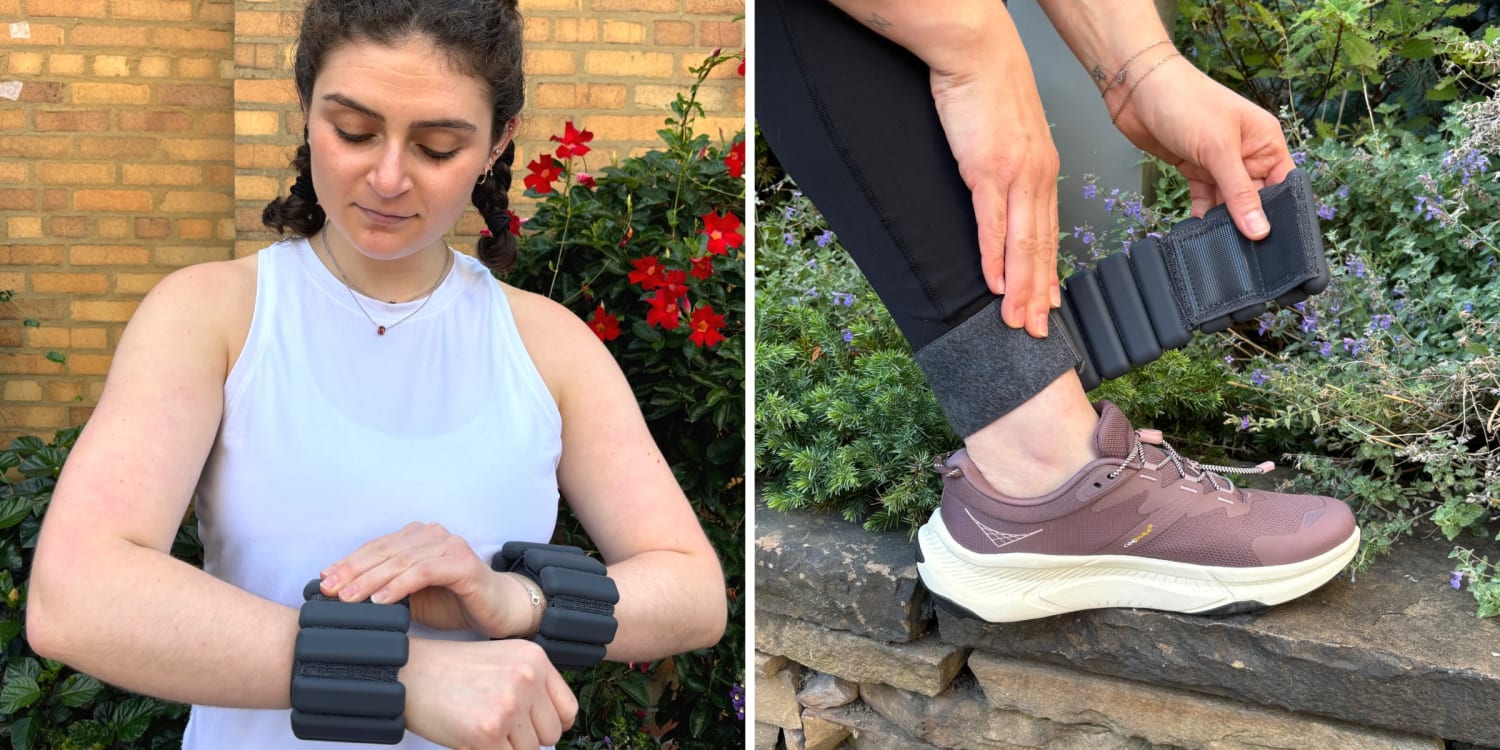
Start with 1–3 pounds total weight (0.5–1.5 pounds per ankle)—this aligns with research showing 1% of body mass optimizes knee proprioception in older adults. Exceeding 5 pounds per ankle risks tendonitis by overwhelming joint torque capacity. Critical rule: Increase duration before weight. Add only 10% more time weekly (e.g., 15→16.5 minutes) rather than heavier loads to build tissue tolerance safely.
Fit Test: Three Non-Negotiable Checks
Your ankle weights must pass these movement tests before use:
– Zero Sliding: Perform 10 leg swings forward/backward—no shifting allowed
– No Chafing: Wear for 10 minutes while walking; red marks mean immediate rejection
– Full Range: Complete ankle circles without restriction; stiff straps limit dorsiflexion
For sensitive skin, wear moisture-wicking socks beneath neoprene models like Gaiam’s $22 adjustable set.
Budget vs. Performance Models
Value pick: Tone Fitness 1lb pair ($5) works for basic exercises but lacks adjustability. Premium choice: Bala Bangles ($55) offer silicone-wrapped steel bars with removable increments—ensuring even weight distribution during dynamic moves like fire hydrants. Avoid fixed-weight models exceeding 2.5 pounds if rehabbing injuries.
Why Science Backs Targeted Ankle Weight Training

Hip Muscle Activation Secrets
That 3-pound load at your ankle multiplies resistance near your hip—activating gluteus maximus 31% harder during single-leg bridges versus unweighted versions. This lever effect makes ankle weight training uniquely effective for posterior chain development, unlike hip-level resistance bands that lose tension at peak contraction.
Proven Body Composition Shifts
2016 clinical trials revealed participants using 0.5kg ankle weights for 20 minutes, 3x weekly:
– Reduced waist circumference by 3.2 inches over 6 months
– Decreased body fat percentage by 2.1%
– Increased skeletal muscle mass without dietary changes
Key insight: 1–2% body-mass loads (e.g., 1.5 lbs for 150lb person) enhance walking distance despite slower cadence—critical for sustainable results.
Medical-Grade Rehabilitation Protocols
Physical therapists prescribe precise ankle weight training for:
– Stroke recovery: 3–5% body-mass loads on affected limbs during balance drills
– Osteoporosis management: 1% loads stimulate bone density gains via osteoblast signaling
– Fall prevention: Improves knee joint repositioning accuracy in adults over 65
Avoid These 3 Injury Traps Immediately
High-Risk Mistakes That Cause Pain
- Running with weights: Creates 7x impact force on knees (treadmills double this risk)
- Extended wear: Over 60 minutes continuously impairs proprioception
- Ignoring joint feedback: Pushing through hip flexor strain leads to chronic imbalances
Pro tip: If your gait shifts (e.g., shorter stride length), remove weights instantly—they’re disrupting natural mechanics.
Medical Contraindications Checklist
Stop using ankle weights if you have:
– Hip or knee replacements within the last 6 months
– Acute ankle sprains or tendonitis
– Balance disorders like vertigo
– Pregnancy complications or recent abdominal surgery
Always consult your physician before rehab-focused ankle weight training.
Pre-Session Safety Drill
- Test movements unweighted—add load only if pain-free through full range
- Clear a 10-foot path for walking sessions to prevent tripping
- Start at 50% planned time (e.g., 7.5 minutes if targeting 15)
- Check joints hourly—any warmth or stiffness means stop immediately
Glute-Building Exercises That Actually Work
Single-Leg Bridge Protocol
Setup: Lie on back, heels near hips, one leg extended straight up
Execution: Squeeze glutes to lift hips until body forms straight line; pause 2 seconds at top
Avoid: Letting hips sag toward floor during descent—this shifts work to hamstrings
Progression: Add 5-degree hip rotation outward for glute medius targeting
Fire Hydrant Technique Fix
Setup: Quadruped position, wrists under shoulders, knees bent 90°
Execution: Lift knee laterally like a dog at a fire hydrant—keep hips stacked
Critical cue: If pelvis rotates, reduce weight; proper form requires core bracing
Advanced: Hold top position 3 seconds while breathing deeply
Bird-Dog Crunch Combo
Start: Extend opposite arm/leg in bird-dog position
Add: Bring elbow to knee under torso while maintaining hip level
Why it works: Ankle weights increase rotational resistance, engaging transverse abdominis 40% harder
Walking Progression Without Joint Damage

4-Week Science-Backed Plan
Week 1: 15 minutes flat pavement walking with 1% body-mass load
Week 2: 20 minutes (33% time increase) on smooth concrete
Week 3: 20 minutes walking + 5 minutes weighted step-ups post-walk
Week 4: Deload—remove weights, do speed intervals (30s fast/90s slow)
Surface Selection Matters More Than Weight
Use: Flat neighborhood streets or indoor tracks—never treadmills. The moving belt creates conflicting forces that amplify joint torque by 22%. Pavement provides stable resistance while grass increases fall risk due to uneven terrain.
Cadence Adjustment Rule
At 1% body-mass loads, expect 5–7% slower steps per minute—but you’ll cover 3% more distance. At 2% loads, walking efficiency reverses. Stick to 1–1.5% for optimal results (e.g., 1.2 lbs per ankle for 150lb person).
20-Minute Beginner Routine (Tested by PTs)
Warm-up: 3 Minutes
- Hip circles: 30 seconds each direction (standing)
- Bodyweight squats: 2×15 reps (slow tempo)
- Ankle rolls: 10 each direction (seated)
Main Circuit: 2 Rounds (15 Minutes)
- Side-lying hip abduction: 15 reps/leg (top leg straight, raise to hip height)
- Prone hamstring curl: 15 reps/leg (lie face-down, curl heel to glute)
- Single-leg glute bridge: 12 reps/leg (focus on glute squeeze at top)
- Fire hydrant: 15 reps/leg (knee lift without pelvic rotation)
Cool-down: 2 Minutes
- Figure-4 stretch: 30 seconds/side (seated)
- Standing quad stretch: 30 seconds/leg (hold wall for balance)
- Calf stretch: 30 seconds/leg (hands against wall)
Smart Progression: When to Level Up
Load Management Hierarchy
Always increase time before weight:
1. Add 10% duration weekly (e.g., 15→16.5 min)
2. Only increase weight when current load feels “easy”
3. Never exceed 3 pounds per ankle without supervision
Example: After 4 weeks at 1.5 lbs/ankle for 25 minutes, try 1.75 lbs—not 2.5 lbs.
Readiness Signs for Heavier Loads
Progress only if you have:
– Completed full routine with zero joint discomfort 24h later
– Maintained perfect form through final reps
– Achieved “relative ease” (RPE 5/10 effort)
– Stability during single-leg movements like standing leg curls
Long-Term Integration Strategy
Ankle weight training shines as an accessory tool, not your primary strength builder. Limit sessions to 20–30 minutes, 3–4x weekly alongside:
– Heavy resistance training (squats, deadlifts) 2x weekly
– Aerobic conditioning (brisk walking, cycling)
– Daily mobility work for hip flexors and ankles
Critical: Remove weights for high-impact activities—running with them increases ACL injury risk by 63%.
Final Note: Ankle weight training delivers precise muscle activation and functional strength when applied with scientific precision. Start light (1–3 lbs total), prioritize flat-surface walking under 30 minutes, and always listen to your joints. Your glutes will grow stronger while your knees stay protected—proving that smarter loading beats heavier loading every time.